SUMMARY
This method enables predictive growth of qubit host materials without the limitations of iterative measurements.
The Unmet Need: Proper characterization of qubit host substrate and in-situ defect growth
Quantum sensors based on electron spin qubits hold promise for a variety of applications ranging from the life sciences to fundamental materials physics.
A major challenge limiting the deterministic and scalable production of single qubits is proper characterization of substrate and in-situ defect growth.
The densities, dimensionalities, and localization required for highly coherent qubits are difficult to harmonize with the current limits of characterization techniques, necessitating a new technique that relies on the quantum dynamics of the system.
The Proposed Solution: Predictive growth of qubit host materials enabled by quantum mechanical calculations
The inventors have developed a method utilizing cluster correlation expansion (CCE) calculations of spin bath-induced decoherence to generate a library of coherence time distributions over a parameter space range.
A maximum likelihood estimation is then performed on a set of experimental data with this library, enabling one to extract the density and dimensionality of qubits incorporated in a host lattice given certain geometrical constraints.
This method simulates the dynamics of the entire interacting spin bath, producing a quantum mechanical characterization technique for quantum applications that can be incorporated into a feedforward synthesis loop.
FIGURE
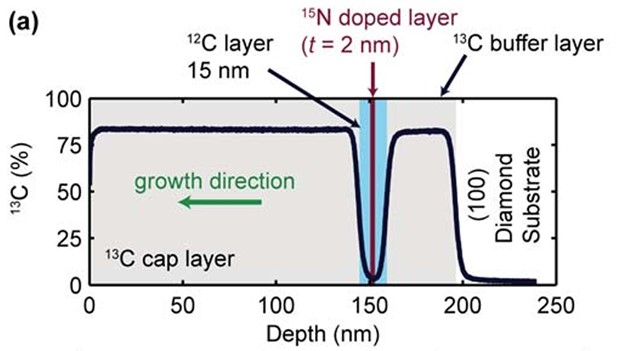
13C atomic percentage, inferred from 13C and 12C SIMS measurements of the 13C/12C/13C isotopically layered structure. A schematic of the sample structure is superposed on the SIMS data, showing the 15N doped layer (thickness 2 nm) as a red line at the center of the 15nm-thick 12C layer.
ADVANTAGES
Advantages
- Compatible with elementary quantum microscope techniques
- Nondestructive to samples
- Compatible with any host material
Applications
- Nitrogen-Based Qubits
- Quantum Sensors
- Quantum Networks
PUBLICATIONS
- Kenichi Ohno, F. Joseph Heremans, Lee C. Bassett, Bryan A. Myers, David M. Toyli, Ania C. Bleszynski Jayich, Christopher J. Palmstrøm, David D. Awschalom; Engineering shallow spins in diamond with nitrogen delta-doping. Appl. Phys. Lett. 20 August 2012; 101 (8): 082413. https://doi.org/10.1063/1.4748280https://arxiv.org/ftp/arxiv/papers/1207/1207.2784.pdf
- Onizhuk, M. and Galli, G. (2021), PyCCE: A Python Package for Cluster Correlation Expansion Simulations of Spin Qubit Dynamics. Adv. Theory Simul., 4: 2100254. https://doi.org/10.1002/adts.202100254https://arxiv.org/abs/2107.05843
March 5, 2024
Proof of Concept
Patent Pending
Licensing,Co-development
David Awschalom