SUMMARY
Innovative therapeutic strategy leveraging commensal microbiota, specifically by oral administration of Bifidobacterium, to enhance anti-tumor immunity, potentially improving cancer treatment when combined with checkpoint inhibitors
Unmet Need: Only 20-40% of patients respond to immunotherapy while a majority experience primary or acquired resistance to treatment
-
The field of tumor immunology has focused significantly on understanding how the immune system can be harnessed to combat cancer. A key area of interest is the infiltration of T cells into solid tumors, which has been shown to correlate with improved patient outcomes. However, the variability in immune responses among individuals poses a significant challenge.
-
Emerging research indicates that factors such as the composition of commensal microbiota can impact anti-tumor immunity. Thus, there is an increased need to explore how manipulating these microbiotas could potentially enhance the body's natural defenses against tumors.
-
Techniques like checkpoint inhibitors target specific proteins to stimulate an immune response, yet not all patients respond equally to these therapies. Additionally, the complex interplay between an individual's microbiota and their immune system contributes to inconsistent treatment outcomes.
-
The unpredictability and variability of immune responses due to differences in microbial composition make it difficult to develop universally effective therapies. Therefore, there is a compelling need to better understand and manipulate endogenous factors, such as commensal microbes, to improve and personalize cancer treatment strategies.
The proposed solution: Oral administration of Bifidobacterium to improve tumor control and abolish tumor outgrowth in conjunction with checkpoint blockade
-
The faculty inventor, Thomas Gajewski, established a method to modulate commensal microbiota to enhance anti-tumor immunity. The distinctiveness of this technology lies in its novel approach to cancer treatment by directly linking gut microbiota composition to immune responses against tumors. The method exploits the symbiotic relationship between host microbial flora and the immune system to induce stronger endogenous anti-tumor responses.
-
The identification and utilization of Bifidobacterium, in particular, demonstrated a targeted microbial approach that synergizes with existing immunotherapies like anti-PD-L1. Animal studies shown with oral administration of Bifidobacterium, either alone or combined with systemic anti-PD-L1 antibody, significantly improved tumor control in mice through a CD8+ T cell-dependent mechanism. Enhanced dendritic cell function was observed, resulting in better CD8+ T cell priming and increased T cell activity within the tumor microenvironment. These outcomes suggest that manipulating commensal microbes can serve as a potential cancer therapeutic. This technology, therefore, opens new avenues for personalized medicine, leveraging individual microbiota compositions to enhance treatment efficacy and offers a complementary strategy to existing oncological practices.
FIGURE
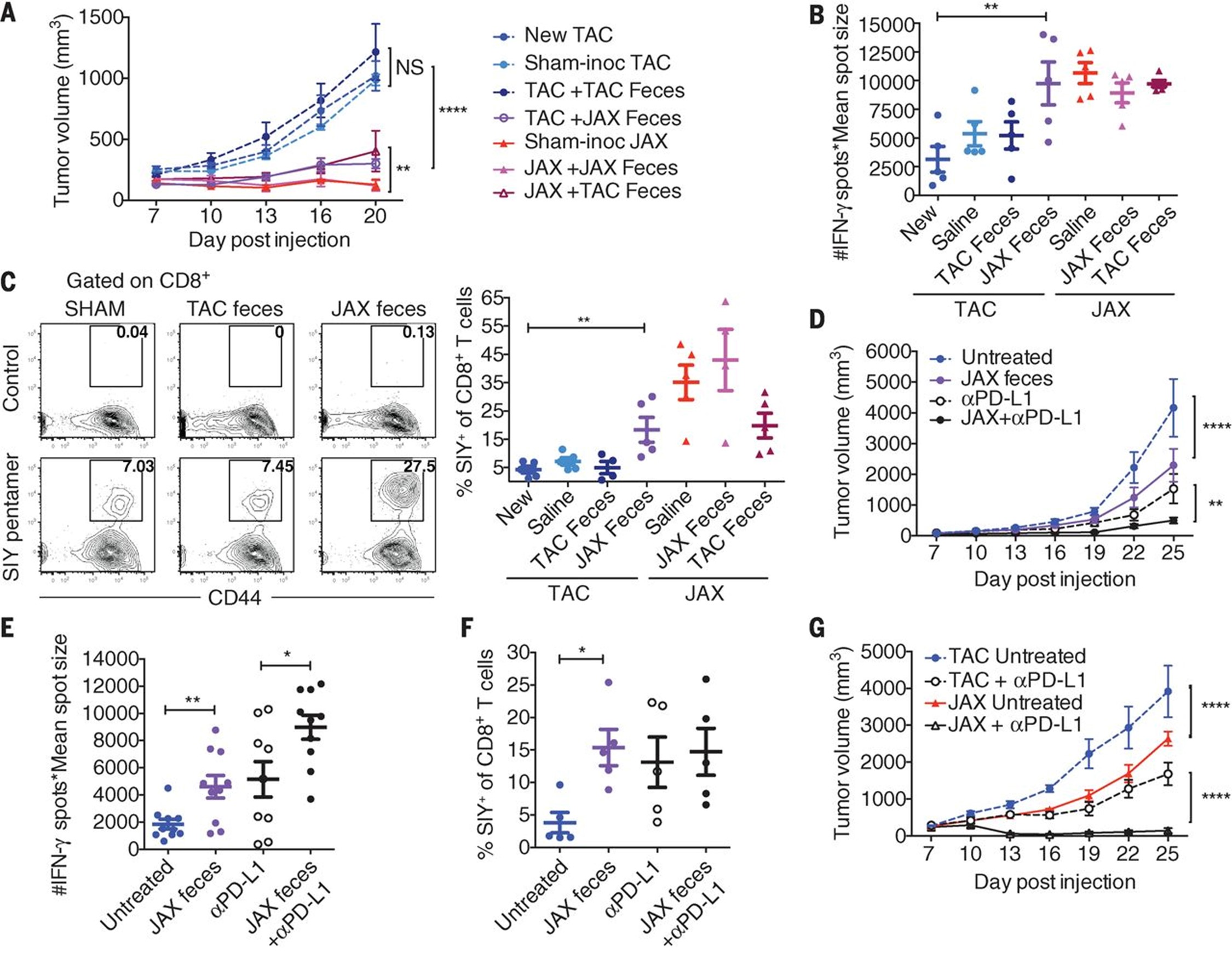
A) B16.SIY tumor growth in newly arrived TAC mice, TAC and JAX mice orally gavaged with phosphate-buffered saline or TAC or JAX fecal material before tumor implantation. (B) Number of IFN-γ spots × mean spot size (10−3 mm2), determined by ELISPOT 7 days after tumor inoculation. (C) Percentage of SIY+ CD8+ T cells within the tumor of TAC and JAX mice treated as in (A), 21 days after tumor inoculation. Representative plots (left), quantification (right). (D) B16.SIY tumor growth in TAC mice, untreated or treated with JAX fecal material 7 and 14 days after tumor implantation, αPD-L1 mAb 7, 10, 13, and 16 days after tumor implantation, or both regimens. (E) IFN-γ ELISPOT assessed 5 days after start of treatment. (F) Percentage of tumor-infiltrating SIY+ CD8+ T cells, determined by flow cytometry 14 days after start of treatment. (G) B16.SIY tumor growth kinetics in TAC and JAX mice, untreated or treated with αPD-L1 mAb 7, 10, 13, and 16 days after tumor implantation. Means ± SEM analyzed by two-way analysis of variance (ANOVA) with Dunnett’s (A) or Tukey’s (D) and (G) correction for multiple comparisons; or individual mice with means ± SEM analyzed by one-way ANOVA with Holm-Sidak correction for multiple comparisons (B), (C), (E), and (F); data are representative of (A) to (C), (F), and (G) or combined from (D) and (E) two to four independent experiments; five mice per group per experiment; *P < 0.05, **P < 0.01, ****P < 0.0001; NS, not significant.
ADVANTAGES
ADVANTAGES
-
Improvement of anti-tumor immunity through microbial manipulation
-
Synergistic effect with checkpoint inhibitors
-
Augmented dendritic cell function and antigen-specific CD8+ T cell priming
-
Increased accumulation of activated T cells in the tumor microenvironment
APPLICATIONS
PUBLICATIONS
July 15, 2024
Proof of concept
Patent Issued
Licensing,Co-development
Thomas Gajewski